I've written about food and I've written about trains, but those were incidental rather than central to the reasons for going to China. So before I totally forget, let me say a little about what we actually did there. We visited two cities, Xi'an and Beijing. The old capital and the new capital. Both have a lot to recommend them, but Xi'an is a lot easier to deal with as a tourist, I suppose because of its smaller size.
Xi'an is home to the famous terracotta warriors, the army that was buried alongside the first emperor, Qin Shi Huang. He died about 200 BC, so they have been there a while. Apparently, his original plan was to bury the real army alongside himself, but his advisers persuaded him that it would be better to bury full size replicas instead. And replicas they are, each one an individual, with his own features and expression. I think they were known of but not located until about 30 years ago, when a local farmer discovered them while digging a well. It was some kind of anniversary when we there and so said farmer was there at the site, signing guide books. They are impressive, not least because there are so many of them. The largest hall is the size of an aircraft hanger. There are infantrymen, archers, cavalrymen, officers and a few generals, all quite distinguishable from each other. Some of them have been set up in exhibition cases so you can get very close to them. But most are left where they were originally set up, rows upon rows in neat formations. They were painted but the paint faded very soon after they were exposed to air and light. There are many still buried and so they are trying to work out a way of uncovering them and preserving the colors.
There are old parts of Xi'an that are pretty well preserved. It has an intact city wall, of varying ages, that is very impressive. It has spectacular gate towers and a road that runs along the top of it. J, D & E rented bicycles to circumnavigate it - took them about 90 minutes. Also impressive were the Drum Tower and the Bell Tower. Apparently, most old cities in China have them, though usually not on this scale. We stayed in the Xianzimen Youth Hostel, which is located near both towers. It is years since I have stayed in a Youth Hostel and I have never stayed in one as good as Xianzimen. It is located in a complex of old building and we had nicely furnished private rooms. It also has a restaurant and a bar, that appeared well liked by the locals. So it had a very nice feel to it, not least because the people that worked there were very friendly and helpful. If you are ever in Xi'an, check it out.
We went from Xi'an to Beijing on the overnight train. Soft sleepers this time so it was pretty plush. It delivered us to Beijing West Railway Station about 11 AM. There we encountered the longest and one of the slowest moving taxi lines I have encountered. The temperature was about -15 C, so we were well and truly frozen by the time we got to the front of the line. In Beijing we stayed in the Happy Dragon Hostel. Not quite up to the Xianzimen standards, but still pretty good. Elizabeth had a hard time in Beijing because the weather was really cold, apparently the coldest it has been for 30 years. I think it went down to -19 C at night and by the time we left, when it had warmed up a little, it was getting up to about -5 C. There was relatively fresh snow on the ground, although it wasn't added to while we were there. We often came across groups of workers, sometimes soldiers who were removing the snow, shoveling it into trucks or smaller bike powered containers.
I really enjoyed visiting the Great Wall. The weather was cold, but also sunny and not windy. Excellent wall- walking weather, in fact. Very beautiful, with the surrounding mountains covered with snow. We walked along it for a couple of hours, sometimes on the flat, sometimes up or down ancient and uneven stone stairs. Local people, who lived in villages outside the wall, set up little booths and tried to sell us very expensive candy bars or hot drinks. They showed great persistence, greeting each new tourist with enormous enthusiasm.
The Forbidden City seemed almost as big as the Great Wall. It just goes on for ever and ever. Interesting buildings, although most of the artifacts there are not particularly well displayed. One exception is the Clock Museum, which has a wonderful collection, mostly presents to 18th and 19th century emperors.
What else did we do in Beijing? We had to visit the Olympic site, of course. The buildings are spectacular, especially lit up at night. We went to the Peking Opera and a bunch of markets and teahouses and, of course, in addition to the fun food that I already write about, we ate some delicious Peking duck.
Sunday, February 7, 2010


Saturday, January 23, 2010
The question is, where do you draw the line between what constitutes food and something you would not put in your mouth in a million years? The Chinese predilection for chicken feet is well known and we have had our share since we have been here. But in Beijing, we decided to take it to another level and visited a market well known for its interesting food. Some things we could recognize, but others were a mystery. But then we were fortunate in finding one of the stall owners who spoke a little English and was very happy to proudly show us all he had available. So we started at his stall and asked for silkworm larvae, scorpion, dog meat and sheep penis. Does that sound like a tasty meal or what! The sheep penis was the surprise on the menu, but there they were, anatomically unmistakable, butterflied and threaded onto a stick. Actually, everything was threaded onto a stick, so that we would never have known the dog was dog if we had not been told. Tasted like chicken, of course, but looked more like little pieces of pork. We wondered about the scorpion tail and whether the venom would survive the cooking process. We ended up breaking off the very tip, just in case.
The method of cooking at this stall was the same in all cases - throw them in the deep fryer, which I appreciated from a food safety point of view. It rendered everything small crunchy. So, if you want to know what a scorpion tastes like, I could tell you its similar to silk worm larvae and both are very crunchy, without having a lot of other flavor. The sheep penis was perhaps a little tougher than other cuts of lamb.
So what could we find to top that? Not much, it turned out. Next we tried a starfish. Surprisingly, that was only shallow fried and it was the only disappointment of the day. The outside was fairly tough and fibrous and only a little crunchy. Inside it was softer, definitely nautical tasting, but not particularly appetizing. It was the only thing that we didn't actually finish. We, in this case, primarily meant Jacob and I. Duncan was the official photographer, although he has a taste of most things, even bending his vegetarian principles for the experience. Elizabeth came along for the ride, but her role was mostly restricted to providing sound effects and expressions of disgust.
We moved on to grasshopper and centipede. The grasshopper would definitely get my vote out of those two. Once the centipede had been deep fried, it was kind of difficult to get it off its stick - or even to tell it apart from its stick. The grasshoppers, on the other hand, better maintained their integrity and provided one of the most pleasant crunches of the meal.
If food and/or protein is in limited supply then the definition of what constitutes food tends tends to get expanded. You can introduce whole new species, as in the Beijing market, but more commonly for meat it means using all parts of the animal. Why just eat the muscle when you have all the organs available? When I was in the market in Mai Chau in Vietnam, I saw very little of the kind of meat that Westerners are accustomed to, and a whole lot more liver, intestines, lungs, skin and feet. We had lunch at HK University of Science and Technology this week and were presented with a dish of fish bladder. I tried it and was wondering if I could still taste any urine, until it was pointed out that this was a gas bladder, used for flotation purposes. That made it taste a whole lot better. It was off white, with a pleasant spongy texture and relatively subtle fishy taste. Chinese people really like it and consider it to be good for the skin. I realized that I have seen it in the fish market all the time without understanding what it was.
The method of cooking at this stall was the same in all cases - throw them in the deep fryer, which I appreciated from a food safety point of view. It rendered everything small crunchy. So, if you want to know what a scorpion tastes like, I could tell you its similar to silk worm larvae and both are very crunchy, without having a lot of other flavor. The sheep penis was perhaps a little tougher than other cuts of lamb.
So what could we find to top that? Not much, it turned out. Next we tried a starfish. Surprisingly, that was only shallow fried and it was the only disappointment of the day. The outside was fairly tough and fibrous and only a little crunchy. Inside it was softer, definitely nautical tasting, but not particularly appetizing. It was the only thing that we didn't actually finish. We, in this case, primarily meant Jacob and I. Duncan was the official photographer, although he has a taste of most things, even bending his vegetarian principles for the experience. Elizabeth came along for the ride, but her role was mostly restricted to providing sound effects and expressions of disgust.
We moved on to grasshopper and centipede. The grasshopper would definitely get my vote out of those two. Once the centipede had been deep fried, it was kind of difficult to get it off its stick - or even to tell it apart from its stick. The grasshoppers, on the other hand, better maintained their integrity and provided one of the most pleasant crunches of the meal.
If food and/or protein is in limited supply then the definition of what constitutes food tends tends to get expanded. You can introduce whole new species, as in the Beijing market, but more commonly for meat it means using all parts of the animal. Why just eat the muscle when you have all the organs available? When I was in the market in Mai Chau in Vietnam, I saw very little of the kind of meat that Westerners are accustomed to, and a whole lot more liver, intestines, lungs, skin and feet. We had lunch at HK University of Science and Technology this week and were presented with a dish of fish bladder. I tried it and was wondering if I could still taste any urine, until it was pointed out that this was a gas bladder, used for flotation purposes. That made it taste a whole lot better. It was off white, with a pleasant spongy texture and relatively subtle fishy taste. Chinese people really like it and consider it to be good for the skin. I realized that I have seen it in the fish market all the time without understanding what it was.
Tuesday, January 19, 2010
So after Vietnam came China. And one of the most interesting things about China was that our major mode of transportation was the China Railways system. The trip was made complex by the bizarre booking system of this system, or should I say the lack of a booking system. You can only buy tickets in the city of departure. So our trip was HK to Guangzhou to Xi'an to Beijing to HK. The first leg was just a 2 hour trip that we have done before. We then took the subway across Guangzhou because the Xi'an train left from a different station. Only then could we buy the tickets for the Xi'an train. After some effort we discovered that the Chinese system is to have the ticket-booking hall in a separate building adjacent to the station. Upon entering, we were met by this vast sea of humanity, roughly organized into lines in front of the 20 or so windows. Careful examination of these revealed the one window staffed by an English speaker. That was the line to join. After waiting our turn, we asked for 5 hard sleeper berths to Xi'an. They were available (fortunately - they often sell out and this train only goes once a day), though not in the same compartment. But we took them and then tried to find our way into the station itself. Basically, it was follow the crowd, through the security lines and into this behemoth of a station that was so overrun with humanity that it made the booking hall look like a quiet dinner for two.
We thought that we would find several restaurants in there for lunch but unfortunately, there were only two, both fast food, one Chinese and one KFC. That explained why there were so many people selling food outside the station, but once inside there was no going back. I figured out where we were supposed to wait for our particular train and joined the hoard there. I noticed enviously that people who had soft sleeper tickets had their own waiting room and even better, a tea room. From time to time they would make announcements in our waiting room, entirely in Cantonese of which we understood not a word. So we just tried to behave like everybody else and line up in the appropriate places. It was kind of funny, we were all lined up at one end of the room, with us at the back, when a new announcement caused everybody to rush to the other end of the room. That meant we were much closer to the front and that was the end from which they started boarding the train. It was all rather mysterious to me because, as far as I know, everybody had an assigned bed or seat on the train and therefore it really did not matter when people boarded.
We found our hard sleeper berths, in two adjacent compartments. They are arranged in bays of 2x3 beds, with the top one not having too much space. Actually they charge less money for the higher ones also. There are no doors on these compartments so they all open directly on the corridor. Thus, we shared the next 25 hours, very intimately with the other people in our compartments, but in the same small world as everybody in our train carriage. There were two women in the bottom beds of my compartment with a very young baby. Elizabeth though neither of them looked like they had just given birth, thus we surmised adoption. Actually, when I woke up the next morning they had all gone, so we had a lot more space. I spent a lot of time sitting in the corridor and watching life come and go. There were many vendors of food. The food was very good, much better than you would encounter on a British or US train, and reasonably priced. You could also buy all sorts of other stuff - my favorite was a necklace that offered all sorts of protections, most notably against radiation damage.
The trip from Guangzhou to Xi'an takes 25 hours. We left at 3 and got in around 4 the next afternoon. The passing landscape was mostly unremarkable, with occasional interludes; many different kinds of houses, lots of big cities, a few mountains here and there. I saw very little unused space. Land without buildings usually had something planted on it. Visibility was often limited by haze. Maybe it was just the weather, but more likely it was pollution. Sometime there was a touch of the Lorax about it.
I did not see any other Westerners on that train - there were lots on the Beijing to HK trip. Jacob in particular had a very nice interaction with some people in the next compartment. I can't remember how it started, but it morphed into an extended language lesson, with most of the benefit coming in our direction.
We had soft sleepers for both of the other long train rides. Not for the nicer waiting rooms but rather because the hard sleepers were all sold out. They were very nice but meant more privacy and therefore greater separation from the other passengers. Duncan really appreciated the soft sleepers. He had been on the very top bunk in the hard sleepers. They control the lights and the PA system centrally for the whole carriage and he was woken up at 7 AM by a bright fluorescent light about a foot from his face. On the trip back to HK I woke him about 10.30 when I was fed up with waiting for the rolls we had bought for breakfast.
Every train carriage comes equipped with a supply of near boiling water and each compartment, both hard and soft, comes with a thermos flask that can be filled with this hot water and then used to make tea. The soft sleepers even come with nice mugs with lids to facilitate that process. Is that civilized or what!
We thought that we would find several restaurants in there for lunch but unfortunately, there were only two, both fast food, one Chinese and one KFC. That explained why there were so many people selling food outside the station, but once inside there was no going back. I figured out where we were supposed to wait for our particular train and joined the hoard there. I noticed enviously that people who had soft sleeper tickets had their own waiting room and even better, a tea room. From time to time they would make announcements in our waiting room, entirely in Cantonese of which we understood not a word. So we just tried to behave like everybody else and line up in the appropriate places. It was kind of funny, we were all lined up at one end of the room, with us at the back, when a new announcement caused everybody to rush to the other end of the room. That meant we were much closer to the front and that was the end from which they started boarding the train. It was all rather mysterious to me because, as far as I know, everybody had an assigned bed or seat on the train and therefore it really did not matter when people boarded.
We found our hard sleeper berths, in two adjacent compartments. They are arranged in bays of 2x3 beds, with the top one not having too much space. Actually they charge less money for the higher ones also. There are no doors on these compartments so they all open directly on the corridor. Thus, we shared the next 25 hours, very intimately with the other people in our compartments, but in the same small world as everybody in our train carriage. There were two women in the bottom beds of my compartment with a very young baby. Elizabeth though neither of them looked like they had just given birth, thus we surmised adoption. Actually, when I woke up the next morning they had all gone, so we had a lot more space. I spent a lot of time sitting in the corridor and watching life come and go. There were many vendors of food. The food was very good, much better than you would encounter on a British or US train, and reasonably priced. You could also buy all sorts of other stuff - my favorite was a necklace that offered all sorts of protections, most notably against radiation damage.
The trip from Guangzhou to Xi'an takes 25 hours. We left at 3 and got in around 4 the next afternoon. The passing landscape was mostly unremarkable, with occasional interludes; many different kinds of houses, lots of big cities, a few mountains here and there. I saw very little unused space. Land without buildings usually had something planted on it. Visibility was often limited by haze. Maybe it was just the weather, but more likely it was pollution. Sometime there was a touch of the Lorax about it.
I did not see any other Westerners on that train - there were lots on the Beijing to HK trip. Jacob in particular had a very nice interaction with some people in the next compartment. I can't remember how it started, but it morphed into an extended language lesson, with most of the benefit coming in our direction.
We had soft sleepers for both of the other long train rides. Not for the nicer waiting rooms but rather because the hard sleepers were all sold out. They were very nice but meant more privacy and therefore greater separation from the other passengers. Duncan really appreciated the soft sleepers. He had been on the very top bunk in the hard sleepers. They control the lights and the PA system centrally for the whole carriage and he was woken up at 7 AM by a bright fluorescent light about a foot from his face. On the trip back to HK I woke him about 10.30 when I was fed up with waiting for the rolls we had bought for breakfast.
Every train carriage comes equipped with a supply of near boiling water and each compartment, both hard and soft, comes with a thermos flask that can be filled with this hot water and then used to make tea. The soft sleepers even come with nice mugs with lids to facilitate that process. Is that civilized or what!
Tuesday, January 12, 2010
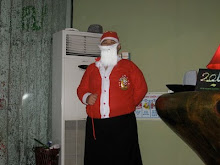
We spent Christmas in Vietnam. Not exactly a hotbed of Christianity, although the French influence has left some churches in Hanoi. We thought it might be nice to escape the rank commercialism that is Christmas in Hong Kong, and indeed it was, although vestiges remained. We saw several Santa-suited bikers on the streets of Hanoi. We went out to dinner on Xmas eve with another Fulbright family from HK. We ate at a relatively up-market restaurant and were greeted there by a Santa. Except that he was a little half-hearted. His beard was pathetic and he was only wearing the top half of the costume. But once we were seated, he came and gave us all a present, attractively packaged in a brown paper bag. Inside was a pair of white cotton tube socks. Everybody got the same adult size, which particularly bemused the young children present. But the food was good and that represented our main Christmas meal. Christmas day itself found us being driven about 4 hours to Halong Bay.
Given limited time and no knowledge, we had opted for a package tour in Vietnam. Buffalo Tours - I would highly recommend them if you want to go to Indochina. So they were taking us to Halong Bay and our small cruise boat that was going to take us around there. HB is one of those breathtakingly beautiful places and a UNESCO World Heritage site. It has these limestone casts that form islands, mostly small rising abruptly out of the waters of the bay. I think there are about 1000 islands in a pretty large bay. It's so gorgeous that everybody wants to go there and so there about 100 boats like ours, cruising the waters. For the most part, there was plenty of room for everybody, although when we visited the caves, we had to wait to get to the dock. I even went kayaking, an unusual event for a landlubber like me, but that way we could get to otherwise inaccessible places. Our boat had 15 passengers and very good food, a good portion of which had come out of the bay.
Actually, Vietnam was good from a culinary perspective, since the other place we went was about the same distance west of Hanoi, Mai Chau, which is up in the hill country. We stayed at a resort there, which catered to us very nicely. It was a small town, surrounded by several small villages, set on a flat plain between two ranges of hills. Quite misty when we were there and also very beautiful. I walked between the rice paddies, which were terraced, though absent of rice since they were between crops. The villages are set up to sell handicrafts to tourist like us, lots of gorgeous scarves and embroideries. We got to enter one house, which belonged to the grandfather of our guide. It was set up on stilts, basically post and beam construction, with a thatched roof and bamboo floor. Large, open, simple and elegant. We did not meet the grandfather, though I would have liked to do so. He had his war medals on the wall and his picture taken with Ho Chi Minh. Next to that was a frame containing 5 photos - Ho, Marx, Engels, Lenin and Stalin. Elizabeth sometimes found it a little difficult being in Vietnam because of the history, but that aspect did not bother me.
Back in Hanoi we went to visit Ho Chi Minh's tomb and the buildings in which he lived. He started off in a colonial palace but then moved quickly on to a smaller building nearby. But he spent most time in a much smaller two storey, four room building that was very simple and beautiful. Seeing his body was interesting. You have to go through all sorts of security and then march up to it two by two. He looks like he died yesterday. People there really seem to like Uncle Ho and see him as a real hero.
Hanoi was a trip. Six million people and 4 million motorized two-wheelers of various kinds, though mostly with pretty small engines. They are used for multiple transport functions. Seeing them carry families of 4 was common, as were livestock (pigs or chickens) and enormous and apparently precarious loads. Would you fell comfortable transporting your new, large, flat screen TV on a motor scooter? There were some cars, lots of taxis and very few buses - public transport is not one of the major achievements of this socialist state. I am a very proficient urban pedestrian and crossing the street in Hanoi required all of my skills. Vehicles take traffic lights as suggestions, rather than commands, and traffic lanes and right of way are alien concepts. But it all seems to work. Although sometimes it felt that were we risking our lives while being driven places, I never saw an accident. Drivers seem to be able to predict the behavior of others and also judge distances very well.
Given limited time and no knowledge, we had opted for a package tour in Vietnam. Buffalo Tours - I would highly recommend them if you want to go to Indochina. So they were taking us to Halong Bay and our small cruise boat that was going to take us around there. HB is one of those breathtakingly beautiful places and a UNESCO World Heritage site. It has these limestone casts that form islands, mostly small rising abruptly out of the waters of the bay. I think there are about 1000 islands in a pretty large bay. It's so gorgeous that everybody wants to go there and so there about 100 boats like ours, cruising the waters. For the most part, there was plenty of room for everybody, although when we visited the caves, we had to wait to get to the dock. I even went kayaking, an unusual event for a landlubber like me, but that way we could get to otherwise inaccessible places. Our boat had 15 passengers and very good food, a good portion of which had come out of the bay.
Actually, Vietnam was good from a culinary perspective, since the other place we went was about the same distance west of Hanoi, Mai Chau, which is up in the hill country. We stayed at a resort there, which catered to us very nicely. It was a small town, surrounded by several small villages, set on a flat plain between two ranges of hills. Quite misty when we were there and also very beautiful. I walked between the rice paddies, which were terraced, though absent of rice since they were between crops. The villages are set up to sell handicrafts to tourist like us, lots of gorgeous scarves and embroideries. We got to enter one house, which belonged to the grandfather of our guide. It was set up on stilts, basically post and beam construction, with a thatched roof and bamboo floor. Large, open, simple and elegant. We did not meet the grandfather, though I would have liked to do so. He had his war medals on the wall and his picture taken with Ho Chi Minh. Next to that was a frame containing 5 photos - Ho, Marx, Engels, Lenin and Stalin. Elizabeth sometimes found it a little difficult being in Vietnam because of the history, but that aspect did not bother me.
Back in Hanoi we went to visit Ho Chi Minh's tomb and the buildings in which he lived. He started off in a colonial palace but then moved quickly on to a smaller building nearby. But he spent most time in a much smaller two storey, four room building that was very simple and beautiful. Seeing his body was interesting. You have to go through all sorts of security and then march up to it two by two. He looks like he died yesterday. People there really seem to like Uncle Ho and see him as a real hero.
Hanoi was a trip. Six million people and 4 million motorized two-wheelers of various kinds, though mostly with pretty small engines. They are used for multiple transport functions. Seeing them carry families of 4 was common, as were livestock (pigs or chickens) and enormous and apparently precarious loads. Would you fell comfortable transporting your new, large, flat screen TV on a motor scooter? There were some cars, lots of taxis and very few buses - public transport is not one of the major achievements of this socialist state. I am a very proficient urban pedestrian and crossing the street in Hanoi required all of my skills. Vehicles take traffic lights as suggestions, rather than commands, and traffic lanes and right of way are alien concepts. But it all seems to work. Although sometimes it felt that were we risking our lives while being driven places, I never saw an accident. Drivers seem to be able to predict the behavior of others and also judge distances very well.
Thursday, December 31, 2009
Duncan got sick just before Christmas with a sore throat and laryngitis. He decided to see what traditional Chinese medicine would do for him. We were with one of my HK colleagues, Pak Sheung, and he volunteered to facilitate the process. First was finding a practitioner. There are plenty of them around, with little shops around the neighborhoods, but Pak wanted to make sure we found a good one. The one he chose, I pass frequently and there is always a line of people, sitting on stools in the store, waiting to see the doctor. I did not experience that part of it (Pak and Elizabeth, along with the patient seemed sufficient), but the doctor felt various energy points and asked several questions before prescribing a concoction that was to be taken for 4 days. It would not be ready until the evening, and in we had to go back for each of the next 4 evenings to pick up a 10 oz paper cup that was filled with the medicine. I don't know the ingredients (barks, leaves, roots, etc.), but it was black and thick and smelled sort of like licorice, but worse. The taste was extremely bad - very bitter, the sort of thing you might give somebody if you wanted them to throw up. I just had a small taste to see what it was like but Duncan was supposed to consume the entire 10 oz. We discovered subsequently that many people have switched to western medicine here because they cannot deal with the taste of these remedies. Duncan did his best, and by the fourth day got down about half of it, but I think he has had his fill of Chinese medicine.
Did it do any good? Hard to say, because he was not that sick and would have got better anyway. Pak's point of view was interesting. He said that experiencing the bitterness was part of the cure. It was part of the price to be paid to get the benefit of health.
Elizabeth enjoyed the football at the East Asian Games- sort of - though we were there for about 5.5 hours which was a little much. So the following, we went to a different marathon activity, Cantonese Opera. Elizabeth's exercise class teacher was performing. There were nine sets of two performers, one playing the female and the other the male role, although they were often both women. The female role was sung in falsetto, which meant it was really high. Each pair only sung one song, but each song lasted about half an hour, so you can do the maths. Everything was in Cantonese, so we had no idea what was going on. Good live music, with a mixture of Western and Chinese instruments, but overall something of an endurance test. The performers are supposed to be singing for the gods, which is just as well as the audience didn't seem to be paying too much attention. Actually, sometimes they were, but at other times they would be having loud conversations with each other or falling asleep. It was an older crowd. We were the only white folk there and also part of the few who were under 60.
I took a break at one point and wandered round the neighborhood in search of some flowers to give to Elizabeth's teacher. They were easily found and more interesting was the scene at the local office of the Hong Kong Jockey Club. It was mobbed, with lots of people spilling into the neighboring plaza, where they were sitting around, perusing the racing paper and often smoking cigarettes. Mostly male, but not entirely so. I think I wrote about going to the races a couple of months back. This is the off- track part of the experience. It looked like the Hong Kong counterpart of a familiar working class British tradition. However, here, the Jockey Club has the monopoly on betting (or legal betting, I should say), so the shops are fewer and the crowds at them larger.
Did it do any good? Hard to say, because he was not that sick and would have got better anyway. Pak's point of view was interesting. He said that experiencing the bitterness was part of the cure. It was part of the price to be paid to get the benefit of health.
Elizabeth enjoyed the football at the East Asian Games- sort of - though we were there for about 5.5 hours which was a little much. So the following, we went to a different marathon activity, Cantonese Opera. Elizabeth's exercise class teacher was performing. There were nine sets of two performers, one playing the female and the other the male role, although they were often both women. The female role was sung in falsetto, which meant it was really high. Each pair only sung one song, but each song lasted about half an hour, so you can do the maths. Everything was in Cantonese, so we had no idea what was going on. Good live music, with a mixture of Western and Chinese instruments, but overall something of an endurance test. The performers are supposed to be singing for the gods, which is just as well as the audience didn't seem to be paying too much attention. Actually, sometimes they were, but at other times they would be having loud conversations with each other or falling asleep. It was an older crowd. We were the only white folk there and also part of the few who were under 60.
I took a break at one point and wandered round the neighborhood in search of some flowers to give to Elizabeth's teacher. They were easily found and more interesting was the scene at the local office of the Hong Kong Jockey Club. It was mobbed, with lots of people spilling into the neighboring plaza, where they were sitting around, perusing the racing paper and often smoking cigarettes. Mostly male, but not entirely so. I think I wrote about going to the races a couple of months back. This is the off- track part of the experience. It looked like the Hong Kong counterpart of a familiar working class British tradition. However, here, the Jockey Club has the monopoly on betting (or legal betting, I should say), so the shops are fewer and the crowds at them larger.
Tuesday, December 15, 2009
For the past 10 days, Hong Kong has been hosting the East Asian Games. We thought we would take advantage by going to see a few events. There are 9 countries competing - China, Taiwan (or Chinese Taipei, as the announcers were told to call it), Macau, Mongolia, Hong Kong, two Koreas, Japan and Guam. We started with table tennis, since it seemed that this part of the world contains the best players. It was very impressive, with four games going on simultaneously, all of which could be seen at once. I tended to find a game that was competitive and watch that one. However, I made an exception to that rule when the two Guam players came out to compete in the singles tournament. They looked like they could have been father and son. Dad was about 40, with a paunch to match, but could move surprisingly well. His 'son' looked younger than Jacob and Duncan. They were absolutely creamed, but took it is good cheer and I bet had a wonderful time in Hong Kong. Actually, I noted in this morning's paper that Guam's total medal haul for the games has been one bronze, so I suspect their experience may have been shared by other members of the Guam team.
We also saw Guam compete in both men and women's Rugby Seven's. Apparently, the biggest sporting event of the year here is the Hong Kong Rugby Sevens, when the best players in the world compete. That wasn't happening here, because, in contrast to table tennis, East Asia is not noted for its rugby prowess. However, they do take it pretty seriously. For those that don't know, Rugby Sevens is a version of the game where each team has 7 players on the field and each half lasts for 7 minutes, with a running clock. The idea is to make the game go very fast and it works that way. It has been added to the next Olympics and so the IOC commissioner was here to give out the medals to denote that fact. Getting creamed at Rugby Sevens looked distinctly more painful than at table tennis. The biggest discrepancies appeared to be with the women, where the Hong Kong and the Guam teams looked like high school girls, in comparison to the much larger and stronger Chinese women. In the first game I saw, the Chinese women beat Hong Kong by 44 - 0. That is a lot of points to score in 14 minutes.
The men's games were more competitive, and in fact Hong Kong heroically beat China to get to the gold medal game against Japan. They almost won that too, but Japan overtook them on the very last play of the game. In Rugby Sevens, the game can only end on a dead ball and since that does not happen very often can get extended beyond those 7 minutes. I get the sense that Hong Kongers have absorbed some of that British plucky losers spirit, so almost winning may feel more comfortable. The Guam teams endeared themselves to everybody after their losses by performing a short excerpt from Michael Jackson's Thriller on their way off the field.
The football was spread out over the duration of the games and we just saw the 3rd/4th playoff for bronze and the gold medal game. And unlike the rugby, only men were competing. The bronze medal game was interesting because it was North vs South Korea. Who knows what was going on in their heads, but they were very nice to each other on the field. Playing hard, but the fouls were fairly benign and they helped each other up after them. The north team looked a little older and a little tougher, but the game ended up as a 1:1 draw. The south prevailed on penalties. One remarkable thing about that (for all you soccer/football aficionados out there) was that the referee had a N Korean player take his kick 3 times. The first 2 attempts were both saved, but the ref said the goalie moved too soon. The goalie got really mad and ended up getting a yellow card for his pains. But he went ahead and saved for a third time, which meant that S Korea had won the game.
On to the final, Hong Kong vs Japan. HK were expected to be the plucky losers once more, but this time they won, again on penalties, much to the delight of the large and raucous crowd. We were sitting right next to the core of the HK support, who came equipped with drums and an enormous flag - probably about 20 x 30 feet. That flag did a complete circuit of the stadium, being dragged across the tops of the crowd's heads. It was interesting to see the enthusiasm with which the HK fans booed the opposing team - seemed a little unAsian somehow. The Japanese scored half way through the first half. But then HK brought on their super sub at the beginning of the second half. He is actually part of the British Premier League's Tottenham side and they allowed him to come home for this game. He only arrived a couple of hours before the game and scored with a nice header about a minute into the half. That was all the scoring, despite extra time and so to the penalties.
We also saw Guam compete in both men and women's Rugby Seven's. Apparently, the biggest sporting event of the year here is the Hong Kong Rugby Sevens, when the best players in the world compete. That wasn't happening here, because, in contrast to table tennis, East Asia is not noted for its rugby prowess. However, they do take it pretty seriously. For those that don't know, Rugby Sevens is a version of the game where each team has 7 players on the field and each half lasts for 7 minutes, with a running clock. The idea is to make the game go very fast and it works that way. It has been added to the next Olympics and so the IOC commissioner was here to give out the medals to denote that fact. Getting creamed at Rugby Sevens looked distinctly more painful than at table tennis. The biggest discrepancies appeared to be with the women, where the Hong Kong and the Guam teams looked like high school girls, in comparison to the much larger and stronger Chinese women. In the first game I saw, the Chinese women beat Hong Kong by 44 - 0. That is a lot of points to score in 14 minutes.
The men's games were more competitive, and in fact Hong Kong heroically beat China to get to the gold medal game against Japan. They almost won that too, but Japan overtook them on the very last play of the game. In Rugby Sevens, the game can only end on a dead ball and since that does not happen very often can get extended beyond those 7 minutes. I get the sense that Hong Kongers have absorbed some of that British plucky losers spirit, so almost winning may feel more comfortable. The Guam teams endeared themselves to everybody after their losses by performing a short excerpt from Michael Jackson's Thriller on their way off the field.
The football was spread out over the duration of the games and we just saw the 3rd/4th playoff for bronze and the gold medal game. And unlike the rugby, only men were competing. The bronze medal game was interesting because it was North vs South Korea. Who knows what was going on in their heads, but they were very nice to each other on the field. Playing hard, but the fouls were fairly benign and they helped each other up after them. The north team looked a little older and a little tougher, but the game ended up as a 1:1 draw. The south prevailed on penalties. One remarkable thing about that (for all you soccer/football aficionados out there) was that the referee had a N Korean player take his kick 3 times. The first 2 attempts were both saved, but the ref said the goalie moved too soon. The goalie got really mad and ended up getting a yellow card for his pains. But he went ahead and saved for a third time, which meant that S Korea had won the game.
On to the final, Hong Kong vs Japan. HK were expected to be the plucky losers once more, but this time they won, again on penalties, much to the delight of the large and raucous crowd. We were sitting right next to the core of the HK support, who came equipped with drums and an enormous flag - probably about 20 x 30 feet. That flag did a complete circuit of the stadium, being dragged across the tops of the crowd's heads. It was interesting to see the enthusiasm with which the HK fans booed the opposing team - seemed a little unAsian somehow. The Japanese scored half way through the first half. But then HK brought on their super sub at the beginning of the second half. He is actually part of the British Premier League's Tottenham side and they allowed him to come home for this game. He only arrived a couple of hours before the game and scored with a nice header about a minute into the half. That was all the scoring, despite extra time and so to the penalties.
Wednesday, December 2, 2009
It has been a while since I have added to this blog. I guess that reflects my current state of busy -ness. Let me survey the last few weeks, since we got back from Korea.
Korea was followed relatively quickly with a trip to Zhuhai. Zhuhai is to Macau what Shenzhen is to Hong Kong, i.e. a city just adjacent to a Special Administrative Region, where economic incentives facilitate rapid growth. However, Macau is not Hong Kong and so Zhuhai has not developed to the same extent as Shenzhen. Maybe at least in part because of that, the PRC government is trying to make it into a center for higher education, establishing branch campuses for several universities. Hence United International College, which bizarrely is a partnership between Honk Kong Baptist University and Beijing Normal University. Christianity and communism combined! However, the HKBU part is dominant and really all that BNU does is to enable HKBU to set up shop in mainland China.
We were at UIC to help with a liberal studies conference/workshop that also involved a number of people from a consortium of Minnesotan Private Colleges. I was particularly impressed with the President of Saint Scholastica in Duluth, who gave a couple of talks with excellent and thought-provoking content.
It was a much more Chinese environment than the more international Hong Kong. Such things are most noticeable for me when it comes to breakfast. Any number of savory dishes - congee (savory rice porridge), noodles, steamed buns of various types, meat and vegetable dishes. One evening we went into town, but UIC provided us with student guides, to take account of language issues and to make sure we did not get lost. Elizabeth and I had a great time with our guide, who unusually was from Hong Kong. We spent the whole evening in a hot pot restaurant, which meant we were given pots of broth, heating on burners at the table, in which we cooked all manner of good stuff.
The provost at UIC has the goal of extending the work we are doing with general and liberal education in Hong Kong to mainland China. Talk about thinking big. Rather overwhelming if you ask me.
So that was a 3-day trip and since then I have helped with workshops at the HK Institute of Education and the HK University of Science and Technology. Plus things have been heating up at PolyU, since I have figured out how to engage with the parts of the university required for me to be effective. In addition I have been working with the General Education Centre here as it plans the transition to a normal academic department. Then the semester is ending so I have had all the usual end of semester stuff with my class.
However, there has still been time for fun stuff, not that the work stuff has not also been fun. There was Thanksgiving in there somewhere, when the Freake/Huebner family cooked. Lacking an oven, we could not host, so we decamped for the afternoon to another Fulbrighter's much larger apartment. Just the afternoon, mind you, because I had to teach in the morning. And the turkey cost the usual weekly food budget.
This past weekend, we had two wonderful outings. The first was to Sai Kung Country Park. It required a 90 minute ferry ride and then close to an hour trek, to get to some fabulous beaches. These beaches came equipped with cafes, which suited me, and big waves, which the surfers enjoyed. Then yesterday we went to one of the HK islands called Cheung Chau. It was just like putting down into a Chinese version of a Mediterranean village. A little bigger and more crowded but a wonderful place to be. You can buy fish in the market and take it to the restaurants to be cooked. And just half an hour by the fast ferry from downtown HK. Not a bad place to live!
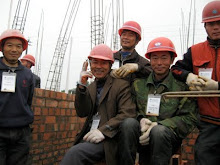
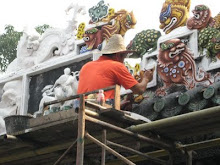
By the way, I am not sure what photos I am going to put up with this narrative. My designated photographers, Jacob and Duncan were off in Sichuan on the Habitat for Humanity. They had a wonderful time there and are now adept bricklayers.
Korea was followed relatively quickly with a trip to Zhuhai. Zhuhai is to Macau what Shenzhen is to Hong Kong, i.e. a city just adjacent to a Special Administrative Region, where economic incentives facilitate rapid growth. However, Macau is not Hong Kong and so Zhuhai has not developed to the same extent as Shenzhen. Maybe at least in part because of that, the PRC government is trying to make it into a center for higher education, establishing branch campuses for several universities. Hence United International College, which bizarrely is a partnership between Honk Kong Baptist University and Beijing Normal University. Christianity and communism combined! However, the HKBU part is dominant and really all that BNU does is to enable HKBU to set up shop in mainland China.
We were at UIC to help with a liberal studies conference/workshop that also involved a number of people from a consortium of Minnesotan Private Colleges. I was particularly impressed with the President of Saint Scholastica in Duluth, who gave a couple of talks with excellent and thought-provoking content.
It was a much more Chinese environment than the more international Hong Kong. Such things are most noticeable for me when it comes to breakfast. Any number of savory dishes - congee (savory rice porridge), noodles, steamed buns of various types, meat and vegetable dishes. One evening we went into town, but UIC provided us with student guides, to take account of language issues and to make sure we did not get lost. Elizabeth and I had a great time with our guide, who unusually was from Hong Kong. We spent the whole evening in a hot pot restaurant, which meant we were given pots of broth, heating on burners at the table, in which we cooked all manner of good stuff.
The provost at UIC has the goal of extending the work we are doing with general and liberal education in Hong Kong to mainland China. Talk about thinking big. Rather overwhelming if you ask me.
So that was a 3-day trip and since then I have helped with workshops at the HK Institute of Education and the HK University of Science and Technology. Plus things have been heating up at PolyU, since I have figured out how to engage with the parts of the university required for me to be effective. In addition I have been working with the General Education Centre here as it plans the transition to a normal academic department. Then the semester is ending so I have had all the usual end of semester stuff with my class.
However, there has still been time for fun stuff, not that the work stuff has not also been fun. There was Thanksgiving in there somewhere, when the Freake/Huebner family cooked. Lacking an oven, we could not host, so we decamped for the afternoon to another Fulbrighter's much larger apartment. Just the afternoon, mind you, because I had to teach in the morning. And the turkey cost the usual weekly food budget.
This past weekend, we had two wonderful outings. The first was to Sai Kung Country Park. It required a 90 minute ferry ride and then close to an hour trek, to get to some fabulous beaches. These beaches came equipped with cafes, which suited me, and big waves, which the surfers enjoyed. Then yesterday we went to one of the HK islands called Cheung Chau. It was just like putting down into a Chinese version of a Mediterranean village. A little bigger and more crowded but a wonderful place to be. You can buy fish in the market and take it to the restaurants to be cooked. And just half an hour by the fast ferry from downtown HK. Not a bad place to live!
By the way, I am not sure what photos I am going to put up with this narrative. My designated photographers, Jacob and Duncan were off in Sichuan on the Habitat for Humanity. They had a wonderful time there and are now adept bricklayers.
Subscribe to:
Posts (Atom)